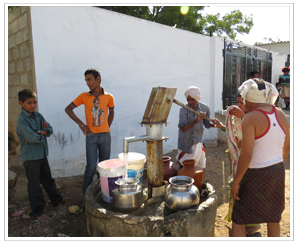
Rural India has more than 700 million people residing in about 1.42 million habitations spread over 15 diverse ecological regions. It is true that providing drinking water to such a large population is an enormous challenge. Our country is also characterised by non-uniformity in level of awareness, socio-economic development, education, poverty, practices and rituals which add to the complexity of providing water.
The pressures of development is changing the distribution of water in the country, access to adequate water has been cited as the primary factor responsible for limiting development. The average availability of water is reducing steadily with the growing population and it is estimated that by 2020 India will become a water stressed nation. Groundwater is the major source of water in our country with 85% of the population dependent on it. Ground water level in India is declining.
India has 16 per cent of the world’s population and four per cent of its fresh water resources. Estimates indicate that surface and ground water availability is around 1,869 billion cubic metres (BCM). Of this, 40 per cent is not available for use due to geological and topographical reasons.
Around 4,000 BCM of fresh water is available due to precipitation in the form of rain and snow, most of which returns to the seas via rivers.
- 92% groundwater extracted is used in the agricultural sector, five and three percent respectively for industrial and domestic sector.
- 89% of surface water use is for agricultural sector
- 2% by the industrial and 9% by domestic sector
It has been already found that the third of the world is suffering from water shortages. Increasing demand for water with rapidly growing rate of population, inadequate rainfall, uncontrolled use of water and climate change are some of the reasons behind it.
The thirst of water for India’s rapid development is growing day by day. Despite rainfall in India, there is large area under the less water conditions/drought prone. There are lot of places, where the quality of groundwater is not good.
Some of the major reasons behind water scarcity are :
It has been already found that the third of the world is suffering from water shortages. Increasing demand for water with rapidly growing rate of population, inadequate rainfall, uncontrolled use of water and climate change are some of the reasons behind it.
The thirst of water for India’s rapid development is growing day by day. Despite rainfall in India, there is large area under the less water conditions/drought prone. There are lot of places, where the quality of groundwater is not good. Some of the major reasons behind water scarcity are;
- Population growth and Food production (Agriculture)
- Increasing construction/ infrastructure development Activities
- Massive urbanization and industrialization throughout the country
- Climatic change and variability- Depleting of natural resources due to changing climate conditions (Deforestation etc.)
- Lack of implementation of effective water management systems
India receives most of its water from south-west which is the most important feature controlling the Indian climate. There is about 75% of the annual rainfall is received during a short span of four months between June to September.
Inadequate rainfall and delay in monsoon has dried up the soil. Climate change will further strain ground water resources, the report said. |